



Trace how banking and financial services became the industry it is: its origins, stalwarts, catastrophes and triumphs.
Industry Essentials 5.0
Certificate in Industry Essentials 5.0 — Banking and Financial Services
IEBFTM · Banking & Financial Services
Build the banking and financial services capability that the sector depends on: planning, sourcing, supplier performance and resilience. Evidence it with a certificate of completion.
Procurement & Supply Chain
Banking & Financial Services
20 Modules
Self paced study
60 Hours
Guided learning time
Free Course
Verifiable digital credential
About the IEBFTM Certification
To give a professional working in or entering banking & financial services a grounded understanding of Industry 5.0, of how this sector operates, and of why supply chain and procurement capability determines whether the sector's transformation succeeds.
Who can join?
Skills You’ll Build
Explain how the sector actually operates: where the money flows, who the players are, and what the rulebook demands.
Describe Industry 5.0, human-centricity, resilience and sustainability, and where it has genuinely landed in this sector.
Recognize why supply chain and procurement capability decides whether the sector's transformation succeeds.
Assess your own organization against the three Industry 5.0 values and its sector risk profile.
See where the SCPMI professional community, its case studies and research close the sector-depth gap.
Core topics
- Banking and Financial Services Fundamentals and Terminology
- Planning and Demand Management in the Banking and Financial Services Sector
- Sourcing, Supplier Selection and Contract Basics
- Supplier Performance, Risk and Continuity
- Cost, Value and Commercial Decision-Making
- Data, Digital Tools and Professional Judgment
Who this certification is for
IEBF is for procurement and supply chain professionals working in or moving into the banking and financial services sector, from those early in their career who want structured grounding, to experienced practitioners who want their existing expertise measured against a published standard.
No prior SCPMI credential is required. Employers use it to give a team one shared vocabulary for banking and financial services.
Procurement & Sourcing
Demonstrate practical knowledge
Supply Chain & planning
Demonstrate practical knowledge
Supplier Management
Demonstrate practical knowledge
Pharrmaceutical Operations
Demonstrate practical knowledge
Quality & Regulatory
Demonstrate practical knowledge
Health Care Procurement
Demonstrate practical knowledge
IEBFTM Curriculum
20 Modules60 guided hours
- The Merchant Who Needed His Money in Two Cities
- The Bill of Exchange: Money That Moved Without Moving
- Double Entry and the Birth of the Ledger
- Florence, Genoa and the First Banking Houses
- What the Medieval Merchant Was Really Buying
- The Supply Chain Hidden Inside a Bill of Exchange
- The Medici: Making a Suspect Trade Respectable
- Nathan Rothschild and the Price of Knowing First
- The Clearing House: Banks Fail Together or Not at All
- The Cost of Being Right Too Early
- What Each Stalwart Actually Changed
- The Correspondent Chain They Left Behind
- The Assumption That Housing Never Falls Everywhere at Once
- How the Risk Models Learned to Lie
- Incentives Pointed the Wrong Way
- The Autumn of 2008
- Reading the Rulebook Backward to the Wound
- Why 2008 Still Shapes How Banks Buy Technology
- The Trillions That Clear While You Sleep
- The Rails Nobody Notices Until They Stop
- How the Plumbing Actually Works
- Building Resilience After the Near Misses
- Why It Is Harder Than It Looks
- The Suppliers Beneath the Rails
- The Deregulation and Securitization Boom
- A Decade of Capital Rules
- The Language Banking Never Retired
- Why Some Trades Still Settle in Days
- Fossils of Decisions Somebody Once Made Seriously
- The Technology Arms Race, Fought Through Vendors
- The Product Is Regulated Trust
- Four Ways a Bank Makes Money
- Where the Costs Actually Sit
- Fixed Against Variable, Made Against Bought
- Who Captures the Margin and Who Just Handles Volume
- What the Bought-In Lines Reveal About the Chain
- From First Contact to Onboarded Customer
- Product and Channel Operations
- The Technology Platforms Underneath
- Risk and Compliance Inside the Flow
- The Handoffs Where Trouble Starts
- The Make-or-Buy Line and How It Moved
- Everyone in the Room
- What a Bank Actually Buys
- Cloud, Data Centers and Market Data
- The Small Physical Estate: Cards, Branches, Secure Documents
- Who Holds Power Over Whom
- Concentrated or Fragmented: How Easily a Supplier Is Replaced
- How a Banking Deal Is Actually Structured
- Licensing the Software and the Cloud
- Service Credits and the BPO Contract
- The Standards and Identifiers the Industry Runs On
- When the Data Formats Do Not Agree
- Cyber Exposure as Supply Risk
- Prudential Rules: The Capital You Must Hold
- DORA and the Outsourcing Rulebook
- Anti-Money-Laundering and the Conduct Regimes
- Who Inspects, Who Certifies, Who Can Shut You Down
- The Fine and the Criminal File
- When Your Supplier Becomes the Regulator's Problem
- Who Works in a Bank and What They Worry About
- The Career Paths and the Qualifications That Carry Weight
- The Ethical Pressure Points
- Displacement in Processing and Servicing
- The Rising Premium on Judgment
- Who Owns the Controls When the Work Is Outsourced
- What Industry 4.0 Optimized For
- The European Commission's Three Values
- Human-Centricity in a Regulated Institution
- Resilience: The Value Banking Was Trained to Neglect
- Sustainability Arrives Late
- Where the Three Values Land on the Supply Chain
- Together, Not in Succession
- What the Machines Carry: Repetition and Scale
- What People Carry: Judgment, Ethics, Accountability
- The Boundary Is Designed, Not Discovered
- The Specific Constraint Banking Faces
- Buying the Automation, Owning the Judgment
- Fraud and AML Detection
- Credit Decisioning by Machine
- Contract Analysis and Client Servicing Agents
- Model Risk Management for All of It
- Deployed Capability Versus Vendor Projection
- When Agentic Systems Act Without a Human in the Loop
- Financed Emissions: The Number Banking Cannot Escape
- The Energy Intensity of the Data Center
- The Branch Estate Footprint
- Regulated, Demanded, or Still Voluntary
- How Fast the Voluntary Column Is Emptying
- What Customers Now Demand of Your Suppliers
- Continuity Through Third-Party Failure
- The Exit Plan Regulators Now Demand
- Efficiency Against the Capacity to Absorb a Shock
- Who Is Entitled to Make the Call
- Why the Answer Is Usually Nobody Until It Is Too Late
- Designing the Chain to Bend, Not Break
- A Handful of Irreplaceable Vendors
- When Commercial Leverage Becomes a Supervisory Matter
- Following One Sourcing Decision All the Way Through
- How Few People Were in the Room
- Exit Planning Before You Need It
- Who Actually Decides, and Who Should
- A Chain Made of Contracts and Data
- Outage, Data Loss, Breach: The New Stockout
- Following One Flow Decision Through the Bank
- Service, Working Capital and Continuity
- Where Operational Reputation Is Made and Lost
- In Banking, the Chain Is the Business
- Running Technology and Services Categories Under a Resilience Regime
- Suppliers as Regulated Dependencies
- What You Now Need to Do That You Did Not Five Years Ago
- The Honest Distance Between the Two
- Why Sector Depth Beats General Competence
- The Knowledge That Walks Out When People Leave
- A Self-Assessment Against the Three Values
- Your Concentration in Core Banking, Cloud and Market Data
- Your Exposure to a Critical Third Party Failing
- Where Your Automation Boundary Sits
- A Readiness View You Can Take Back
- The Part That Should Make You Uncomfortable
20 modules, 60 guided hours, 91 case studies, mastering the journey from vendor to customer through supply chain, sourcing, and procurement.

Who can join?
Built for Real Banking and Financial Services Work
Case Based Learning
Real banking and financial services cases, each with its published source, so you see how the decision actually went.
Knowledge Checks
211 checks across the course, asking about the case you just read rather than the definition.
Story Led Decisions
91 decision points where you make the call first, then see what the organisation really did.
Glossary Flashcards
A flashcard set for every module, built from the 173 terms this course defines.
Choose how you Learn
Self Paced Online
Role focusedlearning
Instructor led Training
Learn at yourown pace
Corporate Training
Verifiabledigital certification

Showcase your pharmaceutical Procurement Expertise
Retail demand planning is not humanitarian logistics. Construction procurement is not technology sourcing.
Every industry has its own regulations, supplier markets, risks, technologies and measures of performance. A qualification designed to apply everywhere cannot reflect every industry’s reality.
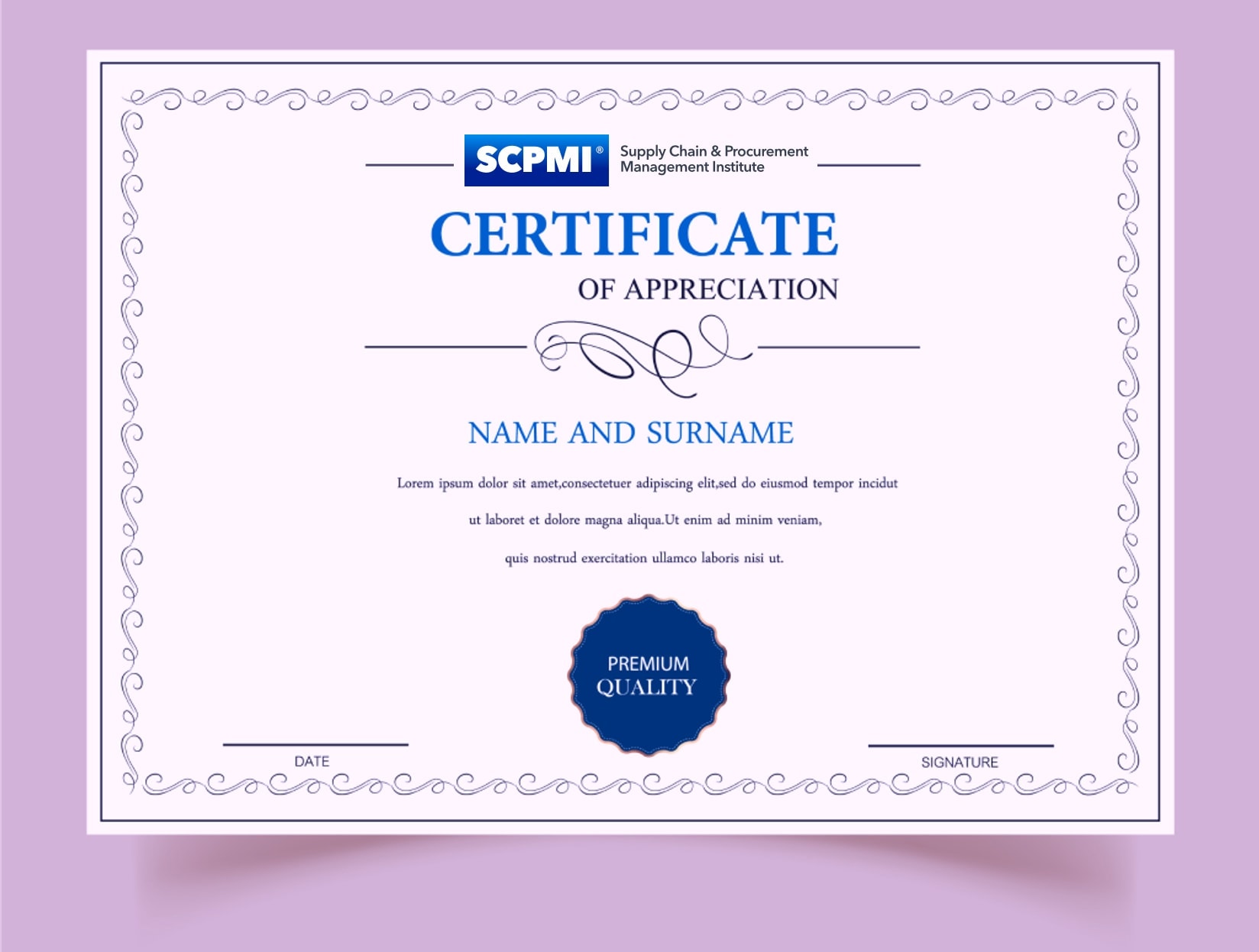
Digital Certificate
Verifiable Credential
Professional recognition
Credential holder profile
Recommended Certifications
CPBFP
4.6 (1,392)
Procurement
Certified Professional in Banking and Financial Services Procurement
20 modules60 hours
$1,295
Enrol Now
CPBFS
4.6 (1,392)
Supply Chain
Certified Professional in Banking and Financial Services Supply Chain
20 modules60 hours
$1,295
Enrol NowIEAG
4.6 (1,392)
Procurement & Supply Chain
Certificate in Industry Essentials 5.0 — Agriculture and Agribusiness
20 modules60 hours
Free
Enrol Now
Frequently Asked Questions
Everything You Need to Know About the SCPMI Community
Find quick answers about who can join, what you can access and how to participate.
A professional space where supply chain practitioners, leaders, educators and learners connect, exchange knowledge and grow together.
Membership is open to anyone working in or moving towards procurement and supply chain — sourcing and supplier management, planning and operations, quality and regulatory, and healthcare procurement among them.
Holding an SCPMI certification first is not a requirement. Many members join while they are still studying and stay on afterwards.
Discussion spaces organised by industry and by topic, alongside shared resources: professional templates, knowledge checks and worked examples of the kind used throughout the certification.
Members exchange ideas, ask questions and solve real-world supply chain challenges with experienced peers rather than working through them alone.
Each Industry Community gathers members who work in the same sector, so the discussion reflects the regulations, supplier markets and risks that sector actually faces. Pharmaceutical procurement sits within Pharmaceutical & Life Sciences.
Where your work spans more than one sector you can follow several, and the wider community stays open to every member.
Start by introducing yourself and following the industry communities closest to your role. From there, taking part is as simple as answering a question, describing how you handled a problem, or posting one of your own.
Members who want a larger part can contribute resources, help newer members find their footing, or join the sessions SCPMI runs through the year.


Build Specialised Capbility in Pharmaceutical Procurement
Connect with professionals, exchange ideas and
continue growing with SCPMI.