



Trace how humanitarian and global health became the industry it is: its origins, stalwarts, catastrophes and triumphs.
Industry Essentials 5.0
Certificate in Industry Essentials 5.0 — Humanitarian and Global Health
IEHGTM · Humanitarian & Global Health
Build the humanitarian and global health capability that the sector depends on: planning, sourcing, supplier performance and resilience. Evidence it with a certificate of completion.
Procurement & Supply Chain
Humanitarian & Global Health
20 Modules
Self paced study
60 Hours
Guided learning time
Free Course
Verifiable digital credential
About the IEHGTM Certification
To give a professional working in or entering humanitarian & global health a grounded understanding of Industry 5.0, of how this sector operates, and of why supply chain and procurement capability determines whether the sector's transformation succeeds.
Who can join?
Skills You’ll Build
Explain how the sector actually operates: where the money flows, who the players are, and what the rulebook demands.
Describe Industry 5.0, human-centricity, resilience and sustainability, and where it has genuinely landed in this sector.
Recognize why supply chain and procurement capability decides whether the sector's transformation succeeds.
Assess your own organization against the three Industry 5.0 values and its sector risk profile.
See where the SCPMI professional community, its case studies and research close the sector-depth gap.
Core topics
- Humanitarian and Global Health Fundamentals and Terminology
- Planning and Demand Management in the Humanitarian and Global Health Sector
- Sourcing, Supplier Selection and Contract Basics
- Supplier Performance, Risk and Continuity
- Cost, Value and Commercial Decision-Making
- Data, Digital Tools and Professional Judgment
Who this certification is for
IEHG is for procurement and supply chain professionals working in or moving into the humanitarian and global health sector, from those early in their career who want structured grounding, to experienced practitioners who want their existing expertise measured against a published standard.
No prior SCPMI credential is required. Employers use it to give a team one shared vocabulary for humanitarian and global health.
Procurement & Sourcing
Demonstrate practical knowledge
Supply Chain & planning
Demonstrate practical knowledge
Supplier Management
Demonstrate practical knowledge
Pharrmaceutical Operations
Demonstrate practical knowledge
Quality & Regulatory
Demonstrate practical knowledge
Health Care Procurement
Demonstrate practical knowledge
IEHGTM Curriculum
20 Modules60 guided hours
- The Evening After Solferino
- Henry Dunant and the Wounded Nobody Came For
- A Memory of Solferino Becomes a Movement
- The Red Cross and the First Geneva Convention
- What Had to Exist Before Relief Could
- The Logistics Hiding in the Founding Story
- Dunant, Ruined and Then Rewarded
- The First Nobel Peace Prize
- Fridtjof Nansen and the Passport That Bears His Name
- A Document for People With No Country
- The Logisticians Who Keep the Cold Chain Cold
- Reformers Move Supplies, Not Just Ideas
- Every Regulation Is a Scar
- The Second Disaster
- When the Donations Clog the Port
- Warehouses Full of the Wrong Thing
- Reading the Rulebook Backward
- Why Procurement Learned to Say No
- Polio at the Edge of Eradication
- A Cold Chain Where There Are No Roads
- Outbreaks Answered in Weeks, Not Years
- Why It Was Harder Than It Looked
- What the Campaign Proved and What It Did Not
- Eradication as a Procurement Triumph
- The Post Cold War Expansion
- Localization and the Shift to National Hands
- Running a Tender in a War Zone
- Evidence Every Dollar
- The Last Mile Is a Motorcycle, a Boat, a Person
- Fossils of Decisions Once Made Seriously
- What the Sector Actually Delivers
- Measured in Lives, Not Margin
- Reading an Operator's Cost Base
- Fixed Against Variable
- Delivered In House or Bought In
- Who Captures Value and Who Just Moves Volume
- From Needs Assessment to Program Design
- Emergency and Framework Procurement
- International Freight and the Border
- In Country Logistics to the Last Mile
- The Handoffs Where It Jams
- The Make or Buy Line That Keeps Moving
- Everyone in the Room
- What the Sector Buys and Moves
- Food, Shelter and the Non Food Item
- Medicines, Vaccines and the Cold Chain
- Pre Positioned Stock and the Surge Shipment
- Concentrated or Fragmented, Can You Replace Them?
- How the Deals Are Really Struck
- Framework Agreements and the Call Off
- The Emergency Waiver
- Donor Restricted Funding and Pooled Procurement
- The Standards the Sector Runs On
- When the Systems Themselves Become the Risk
- Donor Procurement Rules and the Audit
- Sanctions and Counter Terrorism Screening
- Customs and the Import Waiver
- WHO Prequalification for Health Goods
- Who Can Shut You Down
- A Fine or a Criminal File
- Who Works Here and What They Worry About
- Career Paths and the Bodies That Certify
- The Qualifications That Carry Weight
- The Ethical Pressure Points
- Who Actually Carries the Delivery Risk
- Localization as a Transfer of Capability
- The Efficiency Decade and Its Bill
- What Industry 4.0 Left Out
- The Three Values the Commission Named
- Human Centricity, Resilience, Sustainability
- Where the Three Land Unevenly Here
- What the Turn Asks of Procurement First
- Together, Not in Succession
- Where the Machine Carries Scale
- Where the Person Carries Judgment
- A Boundary Designed, Not Discovered
- The Constraint That Sets It Here
- Who Owns the Handoff on the Ground
- Forecasting Needs and Outbreaks
- Optimizing the Pipeline and the Pre Position
- Reading Route and Access Risk
- Deployed Capability Against Vendor Projection
- When the System Acts Without a Human
- What This Changes for the Buyer
- The Account Coming Due
- Packaging and Transport in Constrained Settings
- Speed Against Sustainable Procurement
- Regulated, Demanded or Voluntary
- How Fast the Voluntary Column Empties
- The Buyer Who Pays the Bill
- Response Time Is Not Spent on a Tender
- Pre Positioning and the Framework Agreement
- Supplier Redundancy by Design
- Efficiency Against the Capacity to Absorb
- Who Is Entitled to Make the Call
- Usually Nobody, Until It Is Too Late
- Compliance Decides the Clock
- Framework Design Before the Emergency
- Following One Sourcing Decision
- Its Effect on Cost, Risk and Compliance
- How Few Were in the Room
- The Decision the Beneficiary Never Sees
- The Hardest Last Mile Anywhere
- Where Program Outcomes Are Decided
- Following One Flow Decision
- Service, Working Capital and Continuity
- Reputation Is Made Here, Not in the Product
- The Chain Is the Business
- Compliance, Speed and Cold Chain at Once
- What the Job Now Demands
- The Distance From Five Years Ago
- Why Sector Depth Beats General Competence
- The Knowledge That Walks Out the Door
- What a Business Will Trust You to Decide
- Scoring Yourself Against the Three Values
- Access, Security and the Customs Delay
- Cold Chain Failure and Donor Earmarking
- Pipeline Breaks Between Funding Cycles
- Where Your Automation Boundary Sits
- A Readiness View to Be Uncomfortable About
20 modules, 60 guided hours, 91 case studies, mastering the journey from donor to last mile through supply chain, sourcing, and procurement.

Who can join?
Built for Real Humanitarian and Global Health Work
Case Based Learning
Real humanitarian and global health cases, each with its published source, so you see how the decision actually went.
Knowledge Checks
211 checks across the course, asking about the case you just read rather than the definition.
Story Led Decisions
91 decision points where you make the call first, then see what the organisation really did.
Glossary Flashcards
A flashcard set for every module, built from the 153 terms this course defines.
Choose how you Learn
Self Paced Online
Role focusedlearning
Instructor led Training
Learn at yourown pace
Corporate Training
Verifiabledigital certification

Showcase your pharmaceutical Procurement Expertise
Retail demand planning is not humanitarian logistics. Construction procurement is not technology sourcing.
Every industry has its own regulations, supplier markets, risks, technologies and measures of performance. A qualification designed to apply everywhere cannot reflect every industry’s reality.
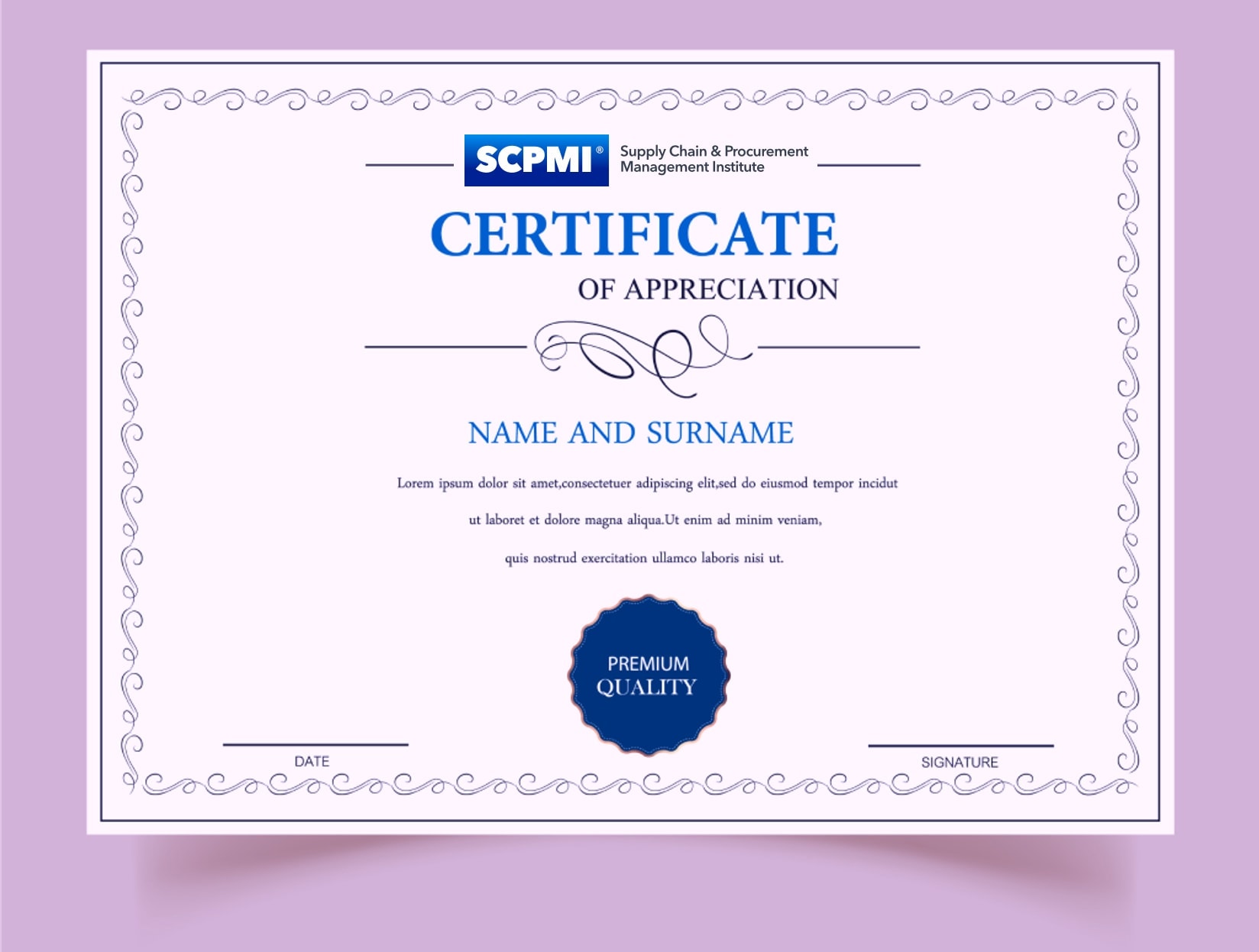
Digital Certificate
Verifiable Credential
Professional recognition
Credential holder profile
Recommended Certifications
CPHGP
4.6 (1,392)
Procurement
Certified Professional in Humanitarian and Global Health Procurement
20 modules60 hours
$1,295
Enrol Now
CPHGS
4.6 (1,392)
Supply Chain
Certified Professional in Humanitarian and Global Health Supply Chain
20 modules60 hours
$1,295
Enrol NowIEAG
4.6 (1,392)
Procurement & Supply Chain
Certificate in Industry Essentials 5.0 — Agriculture and Agribusiness
20 modules60 hours
Free
Enrol Now
Frequently Asked Questions
Everything You Need to Know About the SCPMI Community
Find quick answers about who can join, what you can access and how to participate.
A professional space where supply chain practitioners, leaders, educators and learners connect, exchange knowledge and grow together.
Membership is open to anyone working in or moving towards procurement and supply chain — sourcing and supplier management, planning and operations, quality and regulatory, and healthcare procurement among them.
Holding an SCPMI certification first is not a requirement. Many members join while they are still studying and stay on afterwards.
Discussion spaces organised by industry and by topic, alongside shared resources: professional templates, knowledge checks and worked examples of the kind used throughout the certification.
Members exchange ideas, ask questions and solve real-world supply chain challenges with experienced peers rather than working through them alone.
Each Industry Community gathers members who work in the same sector, so the discussion reflects the regulations, supplier markets and risks that sector actually faces. Pharmaceutical procurement sits within Pharmaceutical & Life Sciences.
Where your work spans more than one sector you can follow several, and the wider community stays open to every member.
Start by introducing yourself and following the industry communities closest to your role. From there, taking part is as simple as answering a question, describing how you handled a problem, or posting one of your own.
Members who want a larger part can contribute resources, help newer members find their footing, or join the sessions SCPMI runs through the year.


Build Specialised Capbility in Pharmaceutical Procurement
Connect with professionals, exchange ideas and
continue growing with SCPMI.